Understanding UTC Offsets and Daylight Saving Time
"What time is it in Tokyo?" seems like it should have one fixed answer, but the honest answer is "it depends on the date" almost as often as it depends on the city. Two concepts explain nearly all of the confusion: UTC offsets, and daylight saving time.
UTC is the reference point, not a time zone you live in
UTC (Coordinated Universal Time) is the neutral baseline every time zone is measured against — nobody sets their clock to "UTC" day to day, but every zone is defined as an offset from it, like UTC+7 or UTC-5. When a world clock shows a city's offset, that's how far its local time sits from this shared reference point, which is what makes comparing two arbitrary cities possible in the first place.
Why the same city can have two different offsets in a year
Many countries shift their clocks forward by an hour in spring and back in autumn — daylight saving time (DST) — to shift more daylight into the evening during the months when the difference matters most. A city that's UTC+1 in January can become UTC+2 in July purely because of this seasonal shift, with no change to its actual geographic position.
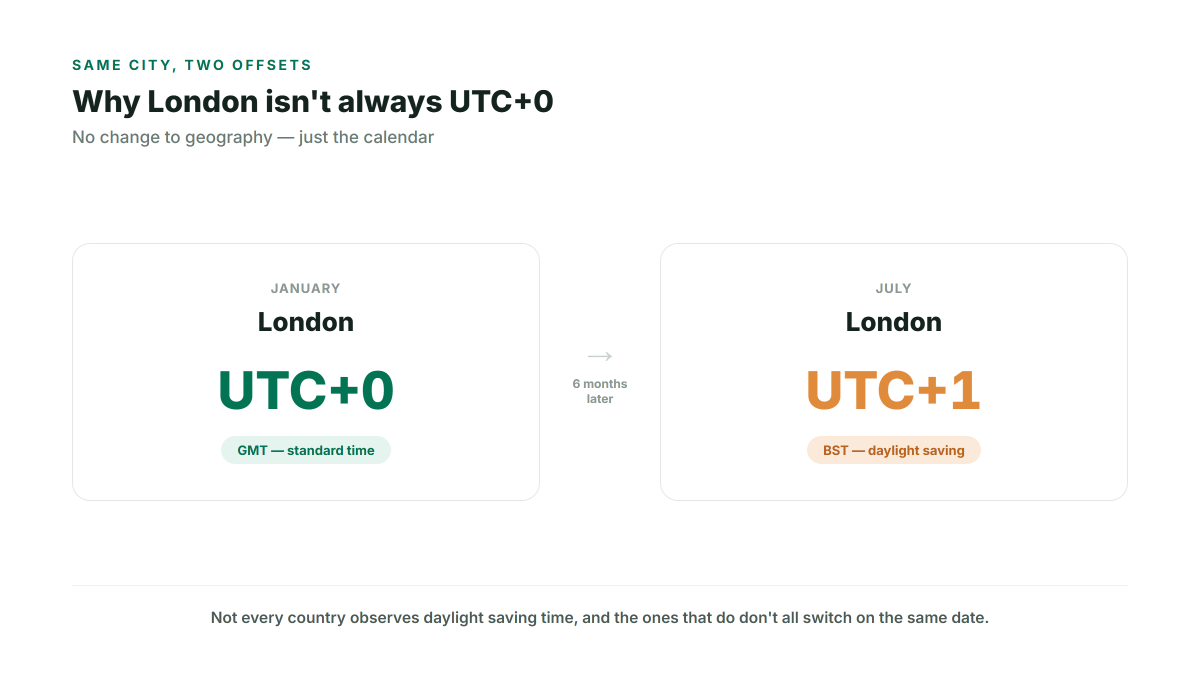
Not every country observes DST, and the ones that do don't all switch on the same date, which is exactly why a time-zone difference you memorized once can quietly become wrong twice a year.
Why this trips up manual calculations
If you memorize "London is 5 hours ahead of New York" in July, that number silently becomes wrong in November, because the UK and the US don't end daylight saving time on the same date. A calculation done in your head has no way to know which of the two cities has already switched — a tool that reads each city's real time zone rules for the actual date in question does.
Where this becomes visible in practice
Click any city in the world clock to open its detail view, which shows its current UTC offset alongside sunrise/sunset times and other local details — and because the offset is computed from the real time zone database rather than a fixed number, it automatically reflects that city's DST status for today, not a number that was accurate when you last checked.
The practical takeaway
Don't memorize offsets — look them up for the specific date that matters, especially for a meeting or event more than a few weeks out. The Meeting Planner guide covers exactly how to do that without doing the arithmetic yourself.